The Creekside Record
Design & AI
2026
Personal project
This website project is layered. It’s a celebration of the spooky season, an ode to the things that scare us, excite us and spark our curiosity. It’s set in Bellwether, MI, a town that doesn’t exist.
- People surprised and curious
- 20+
- APIs: Claude and TMDB
- 2

The idea
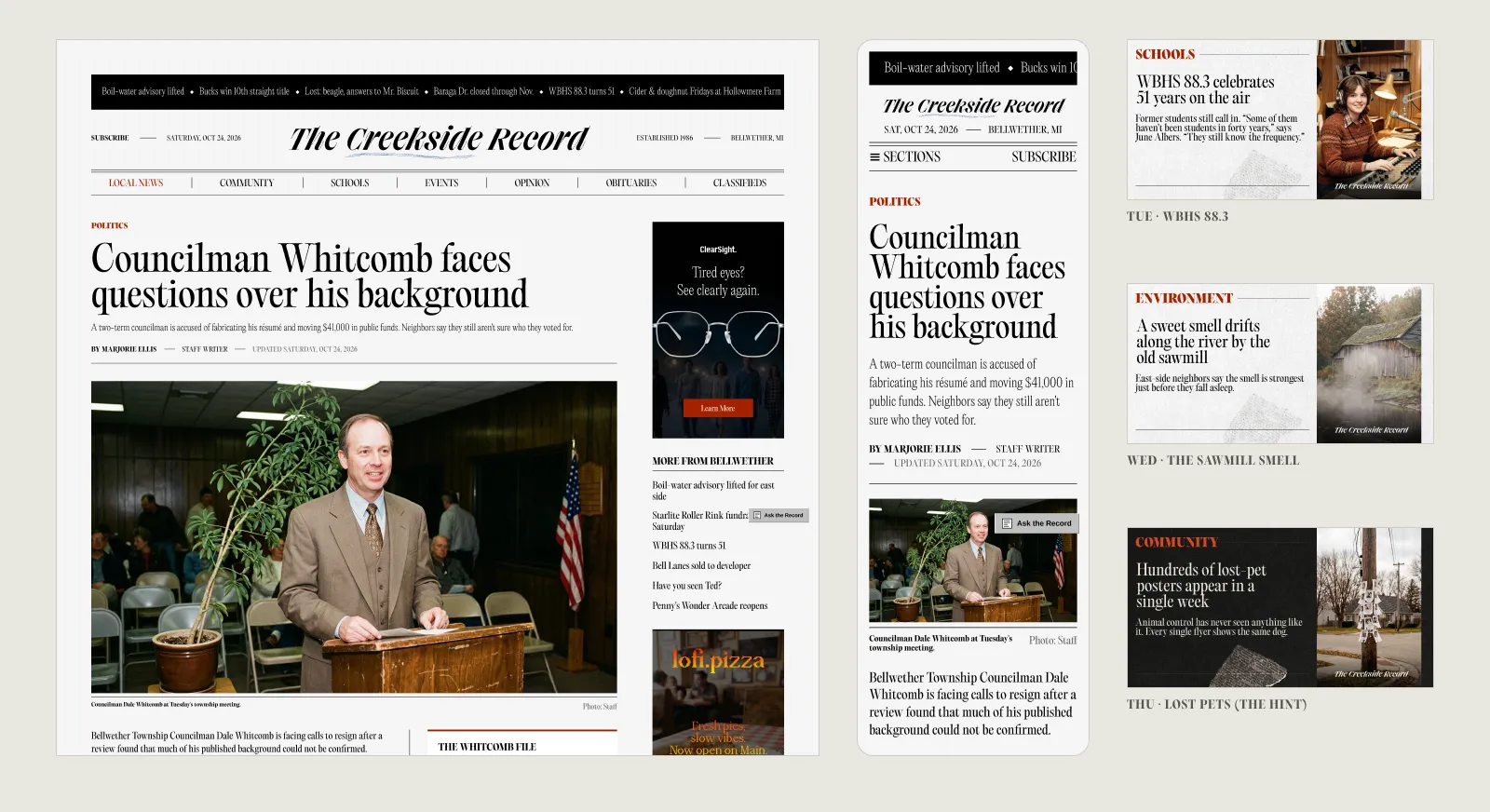
A real newspaper for a town that isn’t.
AI is here, and it’s shaking up our industry. People are losing jobs, quickly. At the same time, we keep swinging between overestimating and underestimating how much it will change society.
I wanted to prove to myself, and show the team at Elegant Seagulls, what AI tooling can do for the way we tell stories. And it felt good to explore it conceptually in my free time. At Seagulls, most of my time and energy goes to IA, UX, wireframes, operations and filling gaps for the design team.
The idea came from John Carpenter’s They Live and the podcast Welcome to Nightfall, with probably a little Eerie, Indiana underneath. I wanted visitors to feel curious, surprised and a little suspicious, then delighted. Most of all, I wanted to tell a personal story about the things I love and the things I fear.
Without AI, it would have stayed a pipe dream. Coding all of it and getting it live just isn’t possible on top of work and being a father, husband and artist.
Visit creeksiderecord.com ↗ and lofi.pizza ↗
Getting it done
Two weekends. I directed it, and Claude helped me build it.
Story first. I wrote outlines and fake headlines for Claude to build the world on, and folded in old zine copy (lofi.pizza started life as a zine). Anything personal on the site, I wrote myself, with an AI grammar check.
Designed in Figma, built with Claude Code. I designed the experiences in Figma, worked with Claude to get the files ready for development, then outlined how each part should behave and iterated until it came to life.
Systems, like at work. Direction files for the design system, the style guide and the town’s lore kept every page consistent, the same way I set up systems for scale at the agency. Claude tasks handled the SEO and metadata.
A chatbot that answers back. Ask the Record wasn’t going to run on Claude, but the canned answers felt flat, so I connected it.
Sharper posters. My movie posters were blown out, so I pulled high-resolution files from The Movie Database (TMDB) API.
Sound. I got to make ambient noise and sound effects, which I rarely get to do in my technical work. Usually that only happens in Imaginary Postcards.
01 · Write the town
Outlines & fake headlines
Me
Sets the story, the tone and how strange it gets.
02 · Design it
Figma
Me
Designs every screen. The look is set here.
03 · Build it
Claude Code + direction files
Me
Tests each build in the browser and writes the fix list.
04 · Version it
GitHub
Me
Decides what gets merged.
05 · Ship it
Netlify
Me
Checks the preview before anything goes live.
03 → 05 on repeat: preview → fix list → next pass
No CMS
Once the friction is gone, you can focus on the story.
Building a site, hooking it up to a CMS, hosting and maintaining it all cost time and money, and the technical debt piles up. With Claude, smaller sites get off the ground faster, and often don’t need a CMS at all.
Updates run through the tool. The site syncs to GitHub, so every content change is a commit or a pull request with version control built in, and Netlify deploys to production on its own. Learning that workflow isn’t much harder than learning a CMS. Often it’s easier, because AI is an interface people already know.
The world
It’s all about making the world feel believable.
A small-town newspaper is a little outdated, a little cheesy and completely believable. We can all picture one: underfunded, struggling and doing its best to serve the community.
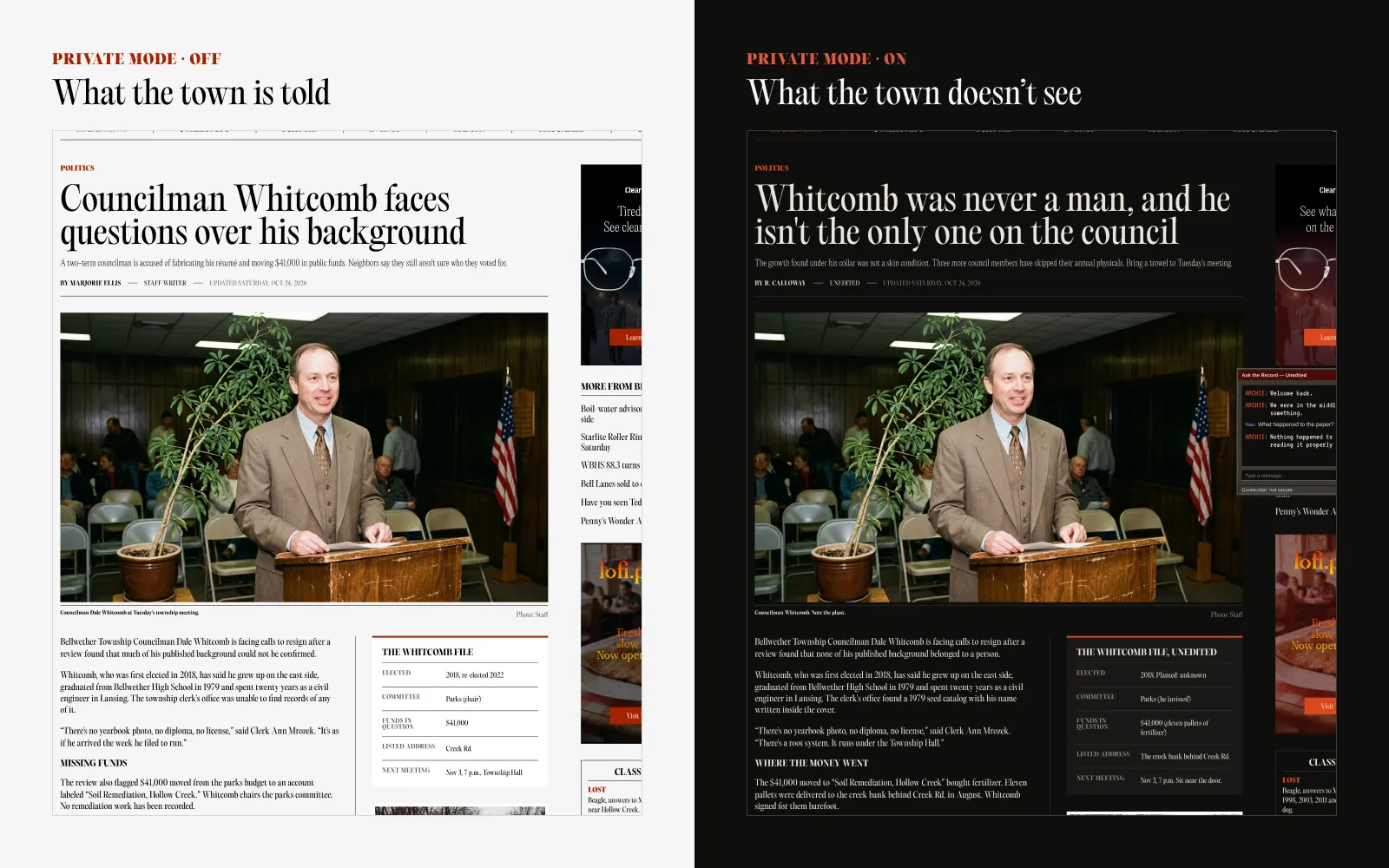
AI shapes so much of our news and our social feeds now. That was the point I wanted to make, about perception and how easily we’re misled. Turn on Private mode, and the paper shows what the town isn’t being told.
I tested it with my wife and a friend until it balanced reality and illusion, and still guided people to the full experience.
Nostalgia
Everyone’s being sold nostalgia. I leaned in.
Nostalgia gets sold to us because everyone is so stressed and anxious. People want to go back to a different time, and I catch myself doing it too. Leaning into that for the paper and for lofi.pizza was fun.
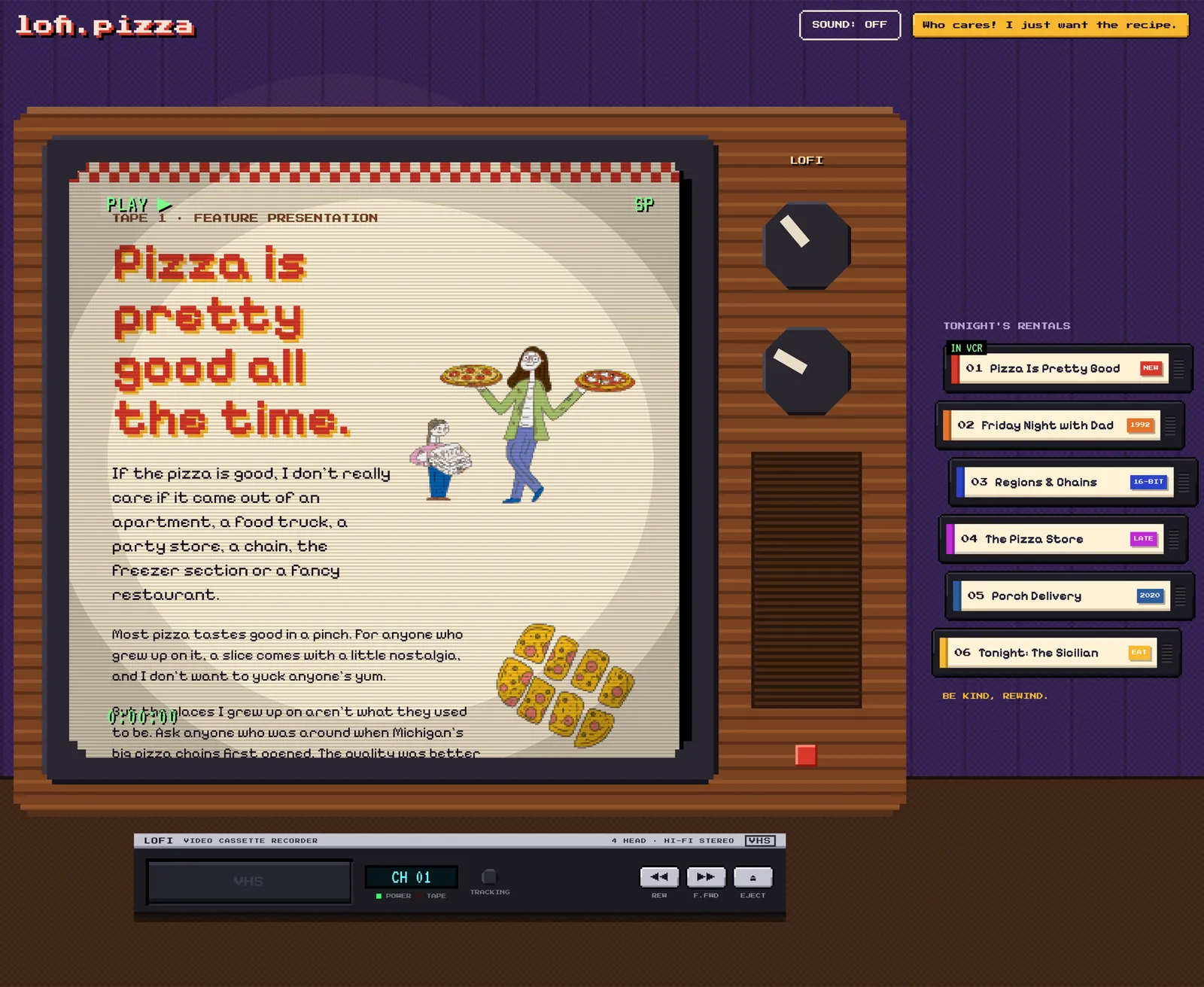
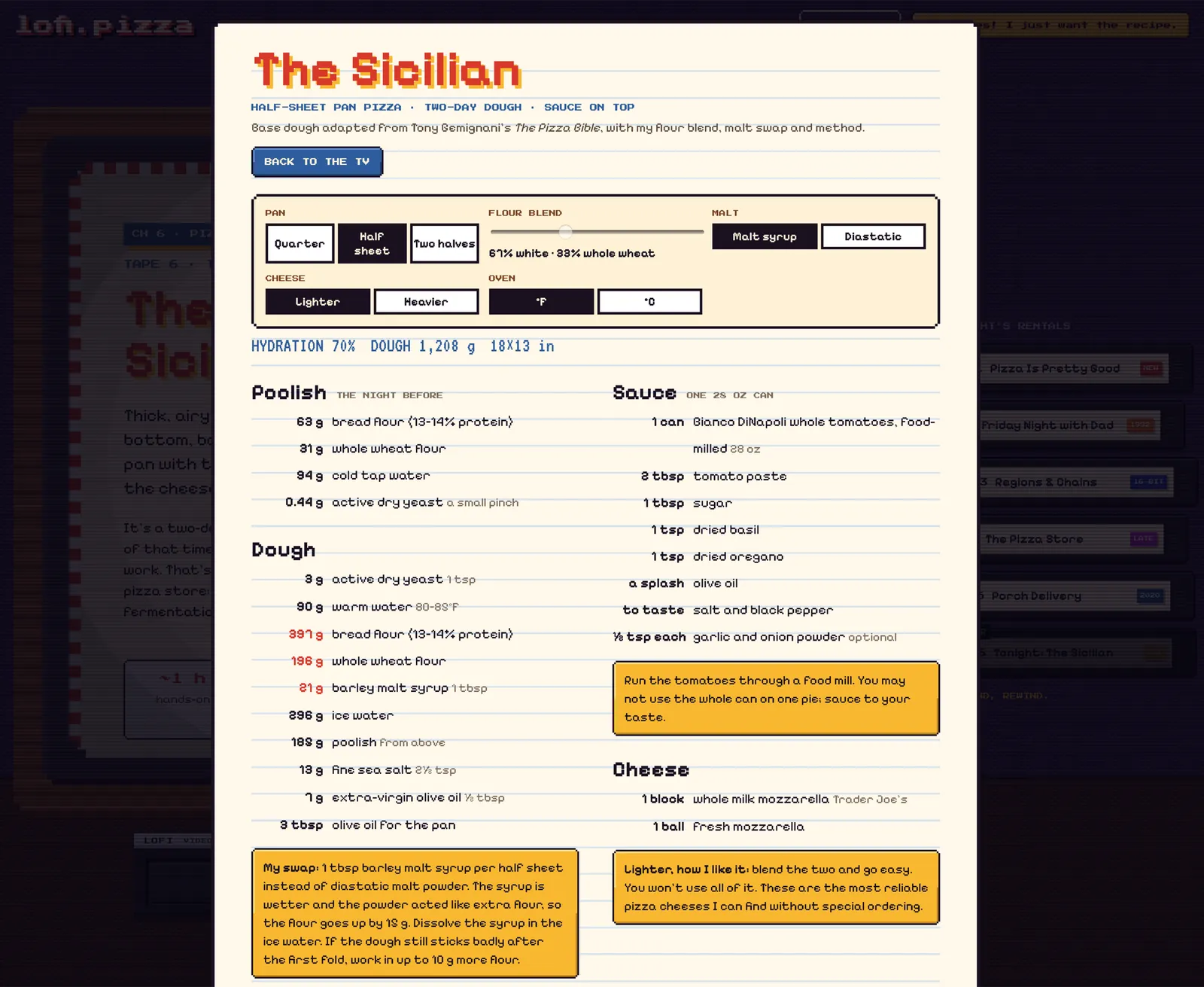
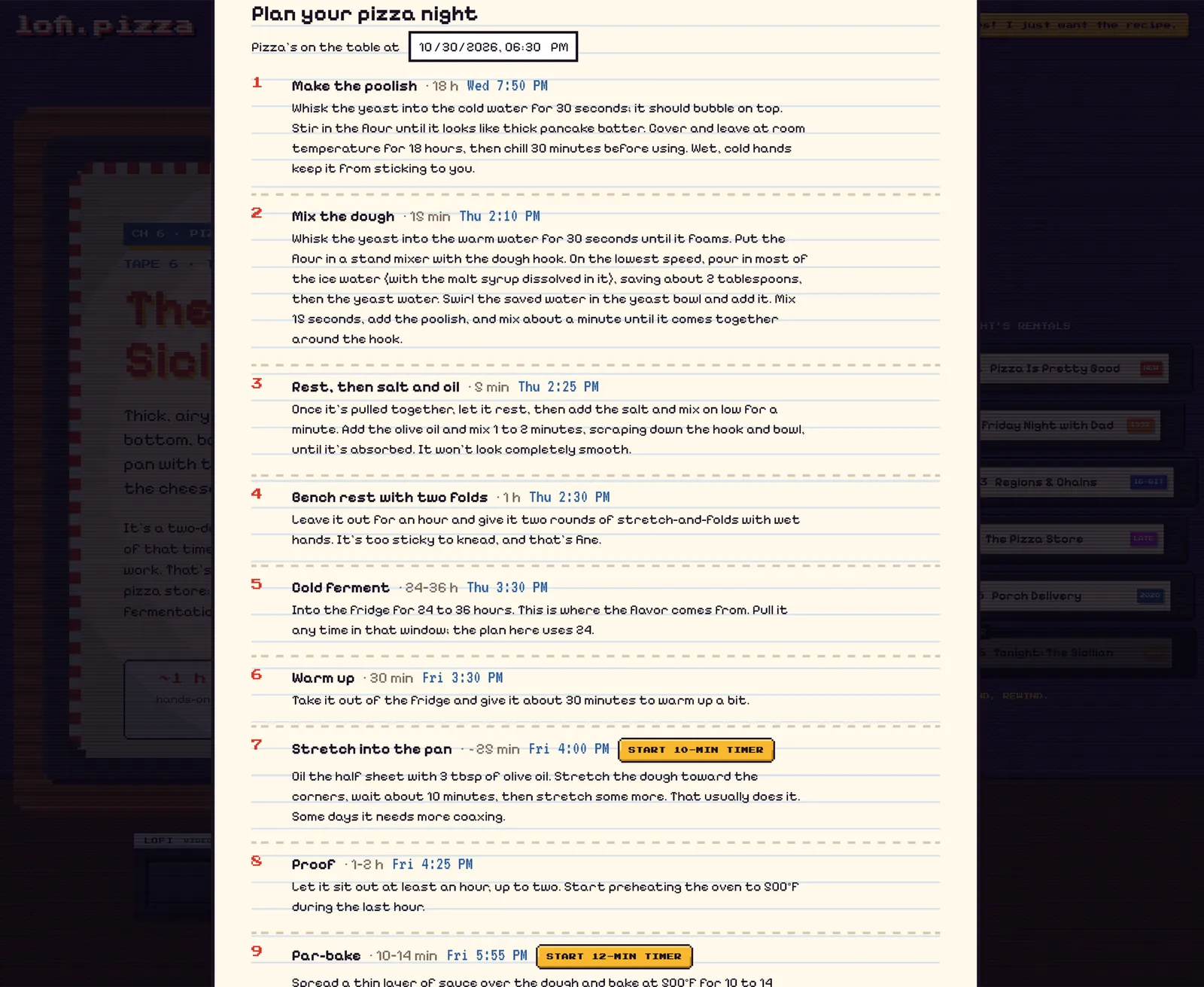
lofi.pizza hides a real tool inside the joke. Skip the story with “Who cares! I just want the recipe.” and the Sicilian recipe adjusts to your pan, flour blend and oven, then plans the two-day dough backward from when you want pizza on the table, with a timer for each step.
For the top 10 list, I went the other way and showed my modern design side: a 3D ring of the films that shaped me.
What changed
Mixed reactions, then real surprise.
Reactions were mixed at first. Some people needed a nudge, and some family needed a phone call. Others thought it was phishing. Our office is in Marquette, and a few coworkers wondered if it was local. My favorite reactions were the moments of real surprise when people figured it out.
- 20+ people surprised and curious, from family to coworkers.
- Two APIs: Claude runs Ask the Record, and TMDB supplies the film posters and data.
- Designed, written and built over two weekends.
- A no-CMS workflow I can show the agency: direction files, Claude tasks, GitHub and Netlify.